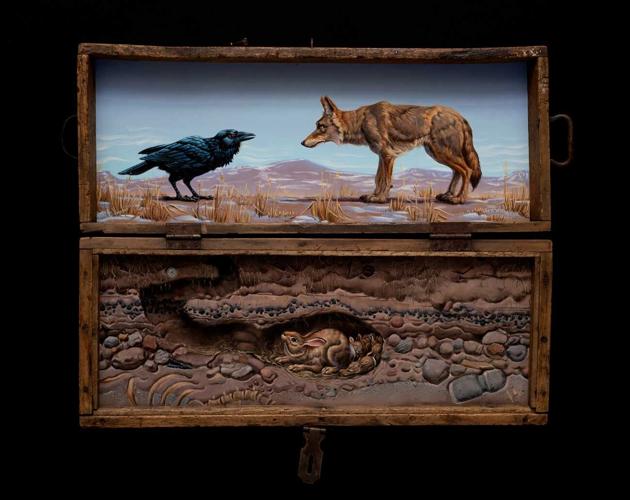
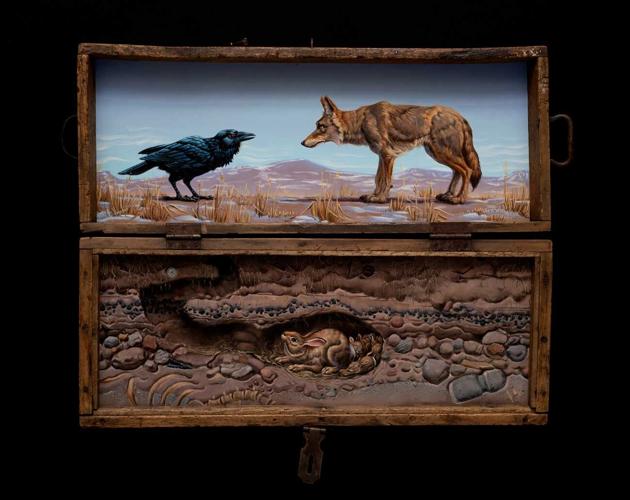
Sage Vogel’s story “El Coyote y el Cuervo/The Coyote and the Crow” starts and ends with Hearing the Truth in EachOther’s Lies (2020), a painting on two canvas panels by Jim Vogel in an antique carpintero toolbox frame by Christen Vogel. Courtesy UNM Press
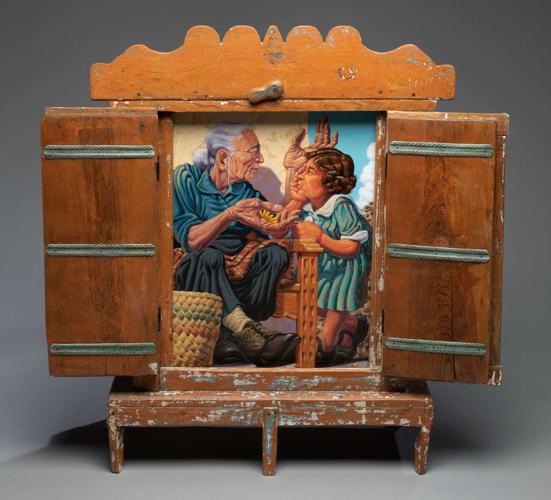
Some paintings by Jim Vogel have the same titles as the stories that they are meant to accompany or inspire. Intercambio (2020), painted inside an antique cabinet frame by Christen Vogel, accompanies the story “El Intercambio/The Exchange” by Sage Vogel. Courtesy UNM Press
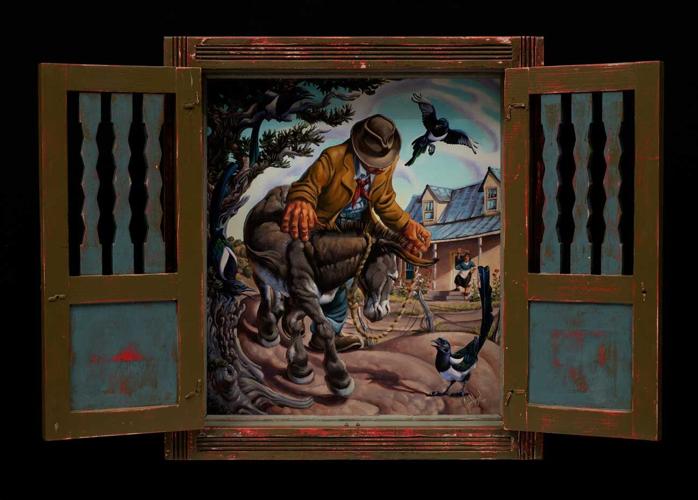
The Magpie and the Burro(2020), a painting by Jim Vogel, goes hand in hand with a short story of the same title in Sage Vogel’s book. It is held in a hand-painted antique wooden frame by the author’s mother. Courtesy UNM Press
Sage Vogel’s story “El Coyote y el Cuervo/The Coyote and the Crow” starts and ends with Hearing the Truth in EachOther’s Lies (2020), a painting on two canvas panels by Jim Vogel in an antique carpintero toolbox frame by Christen Vogel. Courtesy UNM Press
JAMES D HART
Some paintings by Jim Vogel have the same titles as the stories that they are meant to accompany or inspire. Intercambio (2020), painted inside an antique cabinet frame by Christen Vogel, accompanies the story “El Intercambio/The Exchange” by Sage Vogel. Courtesy UNM Press
JAMES D HART
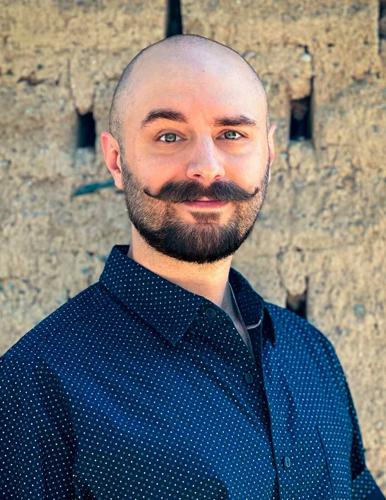
Sage Vogel is the author of Dichos en Nichos. Courtesy UNM Press
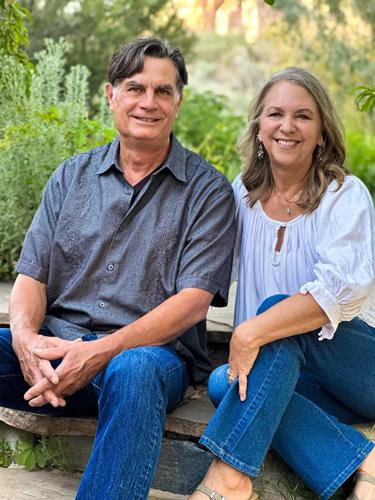
Artists Jim and Christen Vogel, illustrated the book. Courtesy UNM Press
Sage Vogel wants to share a dicho: “Con buenas palabras, no hay mal entendedor.” With good words, there is no misunderstanding.
Vogel was born in Northern New Mexico to Jim Vogel, a painter, and Christen Vogel, a frame artist whose Hispanic roots in New Mexico go back into obscurity, Sage Vogel says. And like so many nuevomexicanos in the region, Sage Vogel grew up hearing Northern New Mexican dichos, poetic proverbs or adages that speak to truth, wherever he’d go.
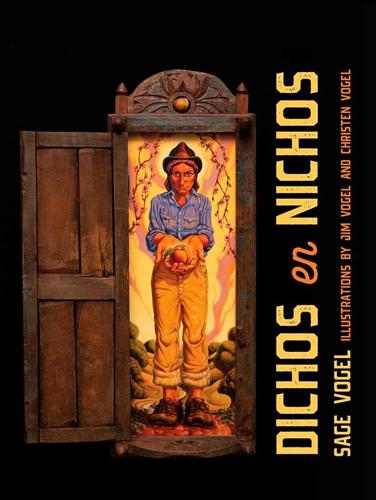
The cover of Dichos en Nichos by Sage Vogel
Dixon, like Chimayó, is one of New Mexico’s dicho capitals. The area was first inhabited by Tiwa-speaking people (Pueblo of Picuris) and later settled by the Spanish under the 1725 Embudo Land Grant. To this day, a little more than 70% of the population identifies as Hispanic. Vogel says local elders, or “old timers” as he calls them, often gather on benches or resalonas outside the community hub in Dixon — the general store and the public library — and as they tell each other stories, they throw in dichos left, right, and center.
It wouldn’t be surprising to hear these elders say things like “Vemos la paja en el ojo del vecino y no la viga en el nuestro,” which translates to, “We see the straw in our neighbor’s eye but not the [wooden] beam in ours” (although “viga” can also mean “fault”). Or even “Gato maulador, pobre cazador,” which means “A meowing cat is a bad hunter,” or big talker but not a doer.
Dichos often dictate good character or moral integrity but are also a good way to learn Spanish. Vogel’s seventh grade Spanish teacher would read one dicho per day to Vogel’s class, for a total of some 180 dichos that Vogel says the teacher may have translated from Spanish to English, or vice versa. Regardless, the teacher read these dichos to his students with such regularity that they soon took hold of Vogel’s imagination.
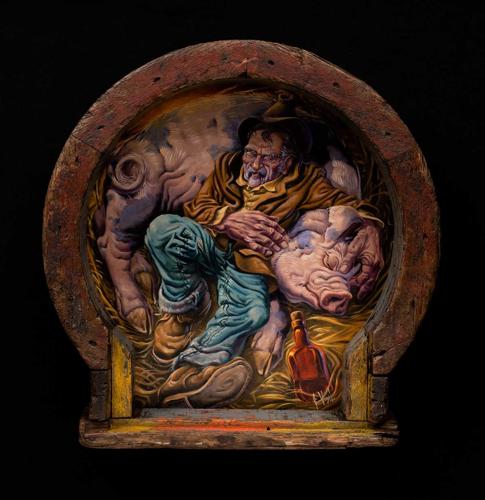
Primo y Cerdo (2020) by Jim Vogel accompanies the story “Bien Pedo/Dirty Stinking Drunk” by Sage Vogel in Dichos en Nichos. Courtesy UNM Press
JAMES D HART
Vogel now works at the same public school he attended as a young boy. He is the school’s new librarian, and it is from that space, surrounded on all sides by books — “I’m spinning around in my chair,” he says, “and all I see is books” — where he talks by phone with Pasatiempo about his own new book, Dichos en Nichos, an English-language collection of short stories sprinkled with Spanish words and phrases, each built around a different dicho.
He has already given a few readings in Santa Fe and Albuquerque to promote the new book, but you can still catch him at an event and discussion on April 19, at the Embudo Valley Library in Dixon. And if you’re lucky and happen to meet one of the elders sitting that afternoon at one of the resalonas in Dixon, you might even hear some dichos spoken in their natural habitat.
The Magpie and the Burro(2020), a painting by Jim Vogel, goes hand in hand with a short story of the same title in Sage Vogel’s book. It is held in a hand-painted antique wooden frame by the author’s mother. Courtesy UNM Press
JAMES D HART
To finish writing Dichos en Nichos — and before he became a librarian — Vogel applied in early 2023 for a grant from New Mexico Writers, an organization that supports New Mexican writers of all levels with grants to writers, poets, and journalists, including a travel grant from author Douglas Preston. The grantees are honored at the annual New Mexico Writers dinner, which is Thursday, April 17, at La Fonda on the Plaza.
In many ways, Vogel and his Dichos en Nichos book is a NMW success story: He completed his book partly thanks to a NMW grant, got a publishing contract from the University of New Mexico Press, and received blurbs from two noteworthy experts on New Mexican culture — UNM professor emeritus and Embudo-born Enrique Lamadrid and Santa Fe-based Don J. Usner, author of Chasing Dichos Through Chimayó. When his book came out in late March, Vogel added to the Northern New Mexican canon of works that help preserve and celebrate a unique Hispanic culture.
Dichos are not unique to New Mexico — we dare you to find a culture that doesn’t have its own sayings, proverbs, or adages. And some of the dichos in Northern New Mexico come originally from Spain. Miguel de Cervantes (1547-1616) had Don Quixote speak from time to time in dichos, or refranes, with phrases like, “La ingratitud es hija de la soberbia” (“Ungratefulness is the daughter of pride”) or one that is also used in Northern New Mexico and goes like this: “Donde menos se piensa salta la liebre” (“The hare shows up where you least expect it”).
But what makes some of the dichos in New Mexico special is that they are a mixture of Hispanic, Native, and Anglo cultures and also that they prevail in modern local parlance.
Vogel’s book is also a testament to his love of storytelling and to his parents’ artistic skills — and, especially, to the beauty of a literary and artistic collaboration between a son and his parents.
Vogel’s parents have supported his storytelling as far back as he can remember. Once, when he was about three, he was in his father’s studio and noticed an old calendar of Western paintings with cowboys and horses. As he looked through the pages, he noticed that a cowboy on one of the pages looked like another cowboy on another page, and he started making up a story in his head while flipping the pages. “But I didn’t know how to write yet,” he says. “So, I dictated the story to my dad. I had him pause his painting work, and I told him the story, and he wrote it down on the calendar, on top of the dates. This was the first book I wrote.”
The calendar story was also his first collaboration with his dad. He later worked on a book with him after he noticed connections between his father’s paintings, which Sage had written little stories for an exhibition. It was also his father who gave him the idea for a book based on nichos that his mother and father would first create. “Dichos are dependent on their context,” Vogel says, and these nichos would inspire a context, or story, around the dicho that Vogel would write.
Nichos are recessed boxes usually with a decorated frame. Vogel’s mother, Christen, who collects antiques and is attuned to finding old frames and objects, would repurpose found objects into nichos, which his father, Jim, then would adorn inside with a painting.
At first, Vogel would write a story based on the dicho and the nicho that his father would have painted, but after a while, inspiration for other stories in Dichos en Nichos became a three-way street: sometimes, Vogel would think of a dicho and his parents would come up with the nicho and the painting; other times, a frame his mother would find and remake would inspire both the painting and the dicho.
“Sometimes, I would try to take the key themes or the key concepts from those images and develop a dicho from there,” Vogel says. “And then, if I had a story idea, I would come to him [my father] and say, ‘Well, maybe we have story that has to do with this or that.’”
The book makes for a beautiful object, both in the literary sense as well as visually. For Vogel, however, it reminds him of how lucky he is to have been able to celebrate his culture and collaborate with his parents on such a meaningful project for all.
“I feel so fortunate,” he says. “The fact that it kind of happened so naturally, it’s hard to describe how it feels. It feels invaluable. It feels like it was meant to be, really.” ◀